



Media, Diversity and Resilience to Disinformation. ChallengeEU Students Take Part in a BIP at UWM
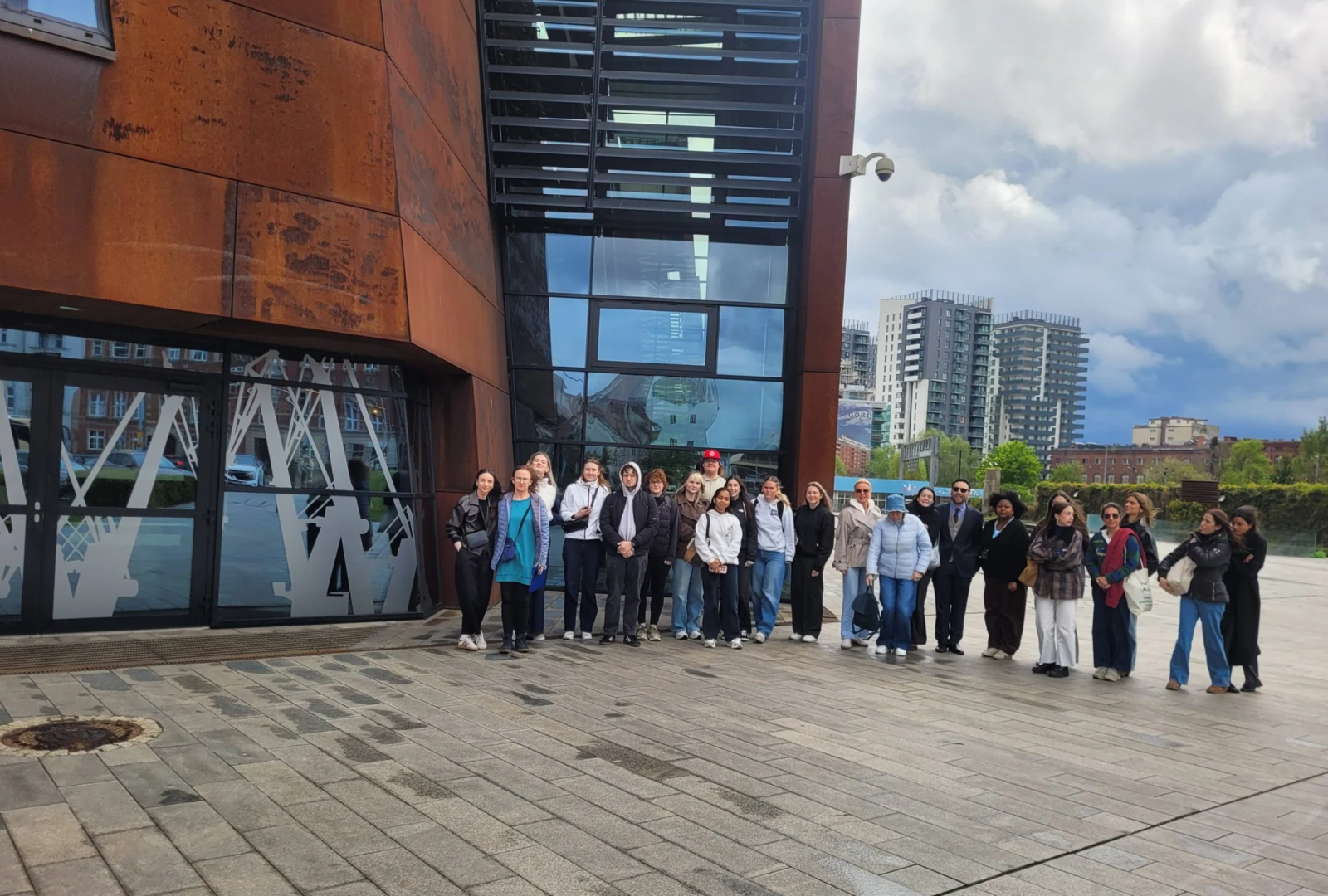
To avoid being misled by disinformation, we need to remain open to other cultures and understand that community can be found in diversity. The Erasmus+ Blended Intensive Programme “Resilience Lab: Media for Social Change”, organised by the UWM Institute of Journalism and Social Communication in cooperation with partner universities from the ChallengeEU Alliance, focused on how media can shape public opinion and support positive social change.
From 11 to 15 May, UWM welcomed students and lecturers from Hochschule Offenburg, Universidade Europeia, and the Latvia University of Life Sciences and Technologies. The programme combined online learning with a short stay at a partner university, enabling international teamwork, the exchange of experiences, and the development of skills useful in modern communication.
"The programme focused on how, through intercultural communication and the creation of social media content, we can raise young people’s awareness of disinformation. Without a doubt, they have the right skills and tools to tackle this problem," explained Dr Marta Więckiewicz-Archacka from the Department of Journalism. She added: "When organising this BIP, we took advantage of the opportunities created by UWM’s membership in the ChallengeEU Alliance, as it makes cooperation with other European universities easier."
Breaking Stereotypes and Making Good Use of Media
During the lectures, participants learned how intercultural communication can strengthen our resilience to disinformation. In practical classes, they learned, among other things, how to create educational content for social media, podcasts, and texts adapted for online publication. An important part of the programme was also a visit to the European Solidarity Centre in Gdańsk, which demonstrated how social movements can lead to real historical and political change.
One of the lecturers from the ChallengeEU partner universities was Prof. Élmano Ricarte from Universidade Europeia in Lisbon, who delivered the lecture concluding the programme. His academic work focuses on intercultural communication and the role of media in building community and dialogue.
"We live in a mediasphere, constantly communicating with one another and trying to understand each other. It is precisely this attempt at mutual understanding that interests me most, because we still do not do it well enough. However, I believe that in the future we will become a better society as a whole, because we will begin to recognise differences and stereotypes while also learning from one another.
The German philosopher Martin Heidegger introduced the concept of ‘Dasein’, which means being in the world. It helps us understand culture and diversity, and Europe is an excellent example of this," said Prof. Élmano Ricarte, also referring to the idea behind the ChallengeEU Alliance.
"Today, unfortunately, we live in bubbles, including educational and scientific ones, which is why every opportunity to come together, share views, and exchange experiences becomes extremely valuable. Europe grew out of such values, and through this alliance we are trying to put them into practice — not only in theory, but also in reality. There is still a great deal of work ahead of us, but I hope that we will soon become better."
Getting to Know Different Points of View
Students emphasised that taking part in the programme allowed them to look at media, communication, and society from an international perspective. For many of them, it was also an opportunity to develop practical skills and build relationships with people from other countries.
"It is a really great opportunity to look at media from an international perspective, as well as to meet people representing other cultures. It teaches us that the world can be seen from many different points of view. I decided to take part in this programme because of my field of study - I want to learn how to use media in a way that allows me to influence others," said Shelsea Arnaldo, a media communication student at Universidade Europeia.
The practical dimension of the classes was also appreciated by Inês Costa, a communication and marketing student at Universidade Europeia.
“" think the topic of this programme is very important for communication students. In class, we usually learn theory, but the practical dimension is often missing. Here, we can work with colleagues from other countries and learn what they have to say and how they see the world," said Inês Costa.
For Monta Paula Leitlante from the Latvia University of Life Sciences and Technologies (LBTU), taking part in the BIP was another opportunity to visit Poland, which she described as her second home.
"I really enjoyed this BIP — the company, the opportunity to get to know other cultures — it was all very exciting. When you stay in your own country, you do not have the chance to experience this, but by taking part in programmes such as BIP or Erasmus+, you can change your perspective and learn a great deal," said Monta, also praising the opportunities offered by the ChallengeEU Alliance.
"It is a great initiative. At my university, I met students from Poland and thought that I simply had to take part in a course like this in Poland. I really appreciate the fact that we have the opportunity to participate in this kind of exchange."
The programme was also attended by Julia Wysocka, an English philology student and ChallengeEU Ambassador at the University of Warmia and Mazury.
"I learned many different things, especially from the practical side — how to create a podcast, how to communicate with people, and how to combine social media with everyday work. I will certainly be able to use everything I learned in my role as an alliance ambassador, because one of our tasks is communication through social media. I applied for this programme because I wanted to gain new skills and meet people from other countries — I want to take every opportunity that comes my way," said Julia Wysocka.
"Resilience Lab: Media for Social Change" showed that international education can be not only an opportunity to gain knowledge, but also a space for building dialogue, community, and resilience to the challenges of the contemporary world.