



LBTU Research Reveals - Peat Additive Improves Pig Growth and Health
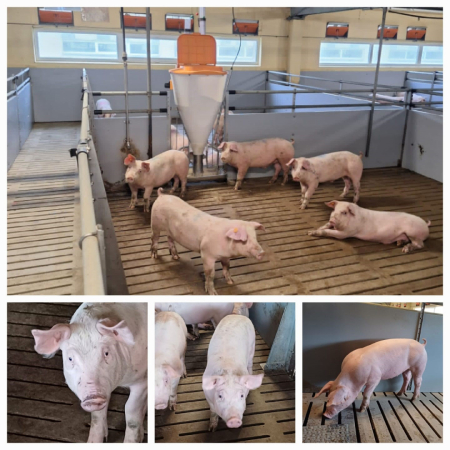
To promote sustainable and environmentally friendly livestock farming, the Latvia University of Life Sciences and Technologies (LBTU), together with representatives of the pig farming sector, launched the project "Exploring the Genetic Potential of Purebred and Crossbred Pigs for Reducing Greenhouse Gas Emissions Using Feed Additives Derived from Renewable Latvian Resources."
The aim of the project is to develop science-based recommendations for optimal pig breed selection and the use of humic substances in feed, contributing to the advancement of climate-neutral pig farming and enhancing the sector's competitiveness.
The study was conducted on two Latvian farms — PF Vecauce Ltd. and Korkalns Ltd. — to evaluate the effects of adding sodium humate, derived from peat, to pigs’ drinking water. Ten groups of pigs, including purebred Landrace and Yorkshire breeds and their crosses with Duroc and Pietrain, were monitored to assess growth performance, feed efficiency, and health.
Results showed that pigs receiving sodium humate had better feed conversion and higher weight gain compared to control groups. In particular, the M1×Duroc crossbred pigs achieved the highest growth rates and most efficient feed utilization. Slaughter data showed minor differences between breeds, with the highest carcass yield (73.1%) observed in the M1×Duroc control group. Experimental pigs had heavier, leaner carcasses, improved nutrient absorption, and fewer digestive issues, while overall health remained stable across all groups.
These first-year results indicate that adding sodium humate to drinking water positively affects pig growth during the fattening phase, improving feed efficiency and weight gain while maintaining good animal health. This approach appears both economically and biologically viable, and further research will continue in the project’s second year.
The project is implemented by LBTU researchers in collaboration with the Latvian Pig Producers Association, Pig Breeding Centre Ltd., Korkalns Ltd., and PF Vecauce Ltd., within the framework of the European Innovation Partnerships, with support from the European Union and the Ministry of Agriculture of the Republic of Latvia.