



Doctoral Thesis on the Factors Determining Smoked Sprat Quality Defended
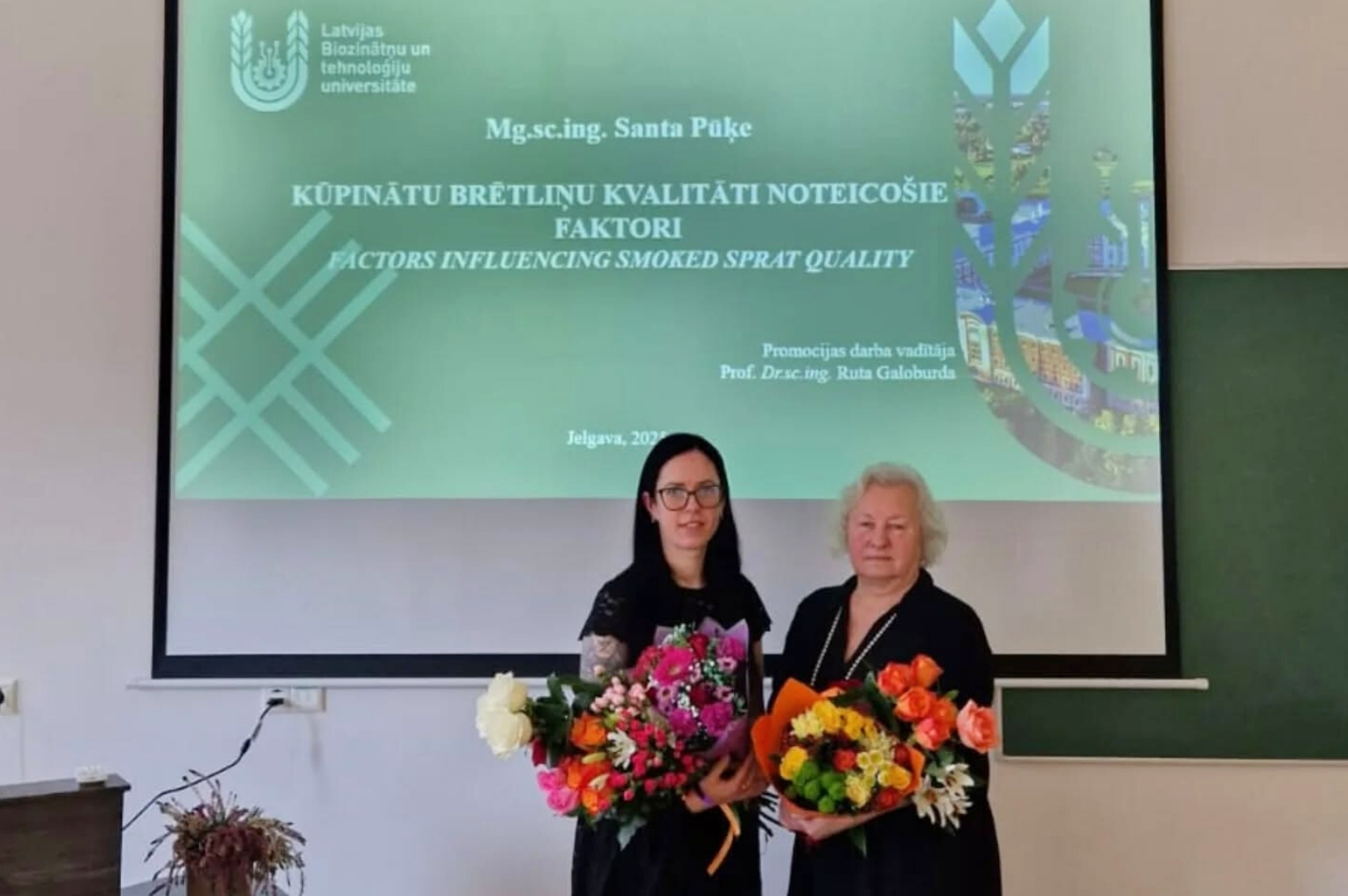
On 29 December, at the Faculty of Agriculture and Food Technology of the Latvia University of Life Sciences and Technologies, Santa Pūķe (ORCID: https://orcid.org/0000-0003-1420-4760) defended a thematically unified set of scientific publications for her doctoral thesis entitled "Factors Influencing Smoked Sprat Quality" and was awarded the degree of Doctor of Science (Ph.D.) in Engineering and Technologies.
The aim of the doctoral thesis is to investigate the factors influencing the quality of smoked sprats in relation to seasonal variation in chilled and frozen sprat quality, and to identify appropriate pre-treatment agents for ensuring product consistency.
The topicality of the research is explained by the author S. Pūķe: "In Latvia, one of the traditional and popular types of fish products is smoked fish. Various species of fish are used for smoking, including sprats. Baltic sprats (Sprattus sprattus balticus) are seasonal fish that are caught from the end of September or the beginning of October until the end of April or the beginning of May, considering external environmental factors such as water temperature and fish spawning time. They are an important source of protein and lipids and can provide at least 20% of the protein required in the human diet. It is known that the quality of fish during the fishing season is variable and depends not only on the quality of the raw material but also on the fishing method and storage conditions. The variable quality indicators of fish affect their usability in production, considering not only seasonality, but also the type of processing (chilled or frozen raw material)."
"Existing literature includes research on Atlantic fish species, their smoking processes, and various processing methods aimed at improving quality. Additionally, studies have examined different techniques for sardine processing and their practical applications. However, there is a notable lack of information regarding Baltic sprats, which are widely available across much of Europe, particularly in relation to their seasonal quality variability. While some studies have described seasonal changes in the lipid and fatty acid composition of sprats and other Atlantic fish species (e.g., mackerel, salmon), comprehensive analyses of the seasonal variation in their overall chemical composition – including lipid, protein, amino acids, and moisture content – remain limited." adds S. Pūķe.
To achieve the aim of the doctoral thesis, the following research objectives have been set: to evaluate the seasonal changes in the physical properties and chemical composition of sprats; to compare the seasonal variations in the texture, colour, and technological parameters (smoking loss, drying loss) of smoked sprats produced from chilled or frozen raw material; to assess the impact of pre-treatment agents on the quality indicators of smoked sprats; to evaluate the influence of pre-treatment agents on the sensory and microbiological properties of smoked sprats, as well as their shelf life.
Scientific supervisor of the doctoral thesis: Professor Ruta Galoburda, Dr. sc. ing., Latvia University of Life Sciences and Technologies (ORCID: https://orcid.org/0000-0002-5804-516X).
The Summary of the Doctoral Thesis is available at this link: https://www.lbtu.lv/sites/default/files/files/notikumi/Puke_Santa_promocijas_darba_kopsavilkums_LBTU_2025.pdf
The Thematically Unified Set of Scientific Publications of the Doctoral Thesis is available at this link: https://www.lbtu.lv/sites/default/files/files/notikumi/Puke_Santa_promocijas_darbs_PT11011_LBTU_2025.pdf


